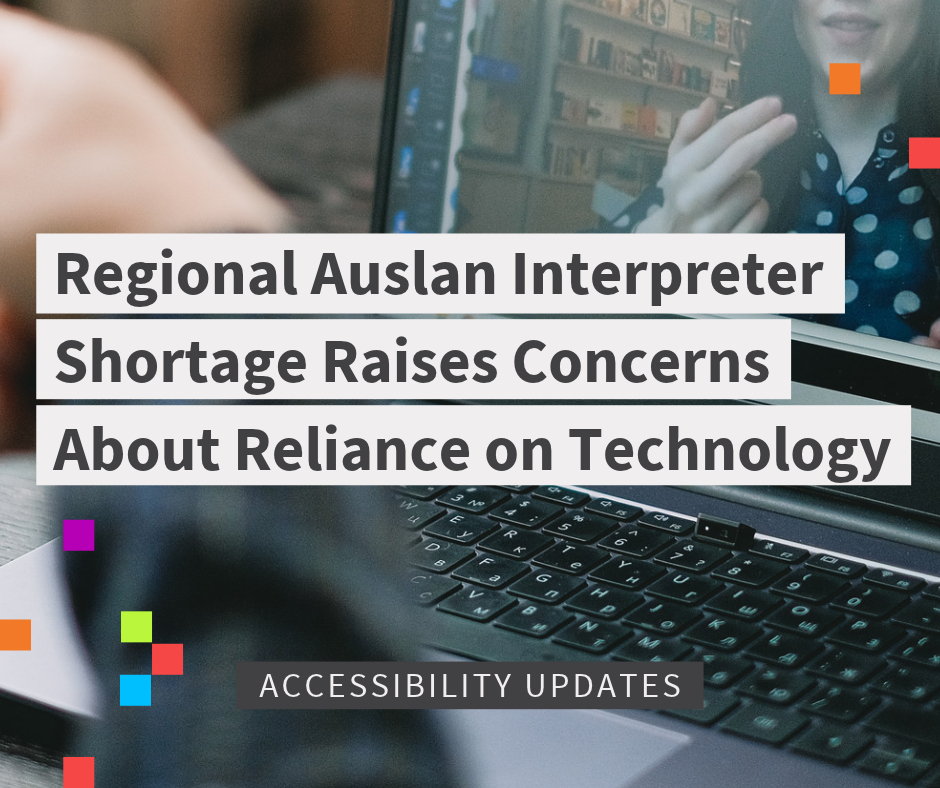
A shortage of Auslan interpreters in regional Victoria is making it difficult for people who are Deaf or hard of hearing to access face-to-face interpreting, while greater use of video interpreting and artificial intelligence (AI) is changing how these services are delivered.
According to the ABC, regional communities have long faced difficulties finding and booking Auslan interpreters. Video interpreting services and AI-powered live captioning are increasingly being used when an interpreter cannot attend in person.
However, concerns have been raised that these options are sometimes being offered instead of available face-to-face interpreters.
Regional Auslan interpreter Cindy Murray told the ABC she left the profession earlier this year after experiencing difficulties securing work. She said agencies were often reluctant to cover travel costs or prioritise in-person interpreting over video services.
This creates a complicated situation in regional areas, where Deaf people may be told that an in-person interpreter is unavailable while interpreters living in the region report difficulty finding work.
Technology can provide another option, but it does not necessarily offer the same service. Auslan is a distinct language with its own grammar and structure, meaning AI-generated captions of spoken English are not a direct replacement for Auslan interpreting. Live captioning also does not translate a person’s Auslan response back into spoken English.
Deaf Connect Chief Services Officer Brent Phillips told the ABC that customer preference remained important and that the organisation would try to provide an in-person interpreter when requested. While Deaf Connect is monitoring developments in AI and sign language technology, Mr Phillips said the organisation did not see AI as a replacement for interpreters.
Video interpreting can also help address shortages without replacing the human interpreter. Deaf Victoria Regional Outreach Officer Gary Kerridge has been involved in a trial of Convo, an on-demand video interpreting app that connects users with qualified Auslan interpreters remotely.
Mr Kerridge said online interpreting could reduce costs and improve access when an interpreter could not attend in person, but not every interpreting situation was suitable for online delivery.
The growing range of interpreting options may help people in regional communities access services more quickly. However, the experiences highlighted by the ABC also show the importance of maintaining a regional Auslan interpreting workforce and ensuring Deaf people can choose the type of communication support that works for them.