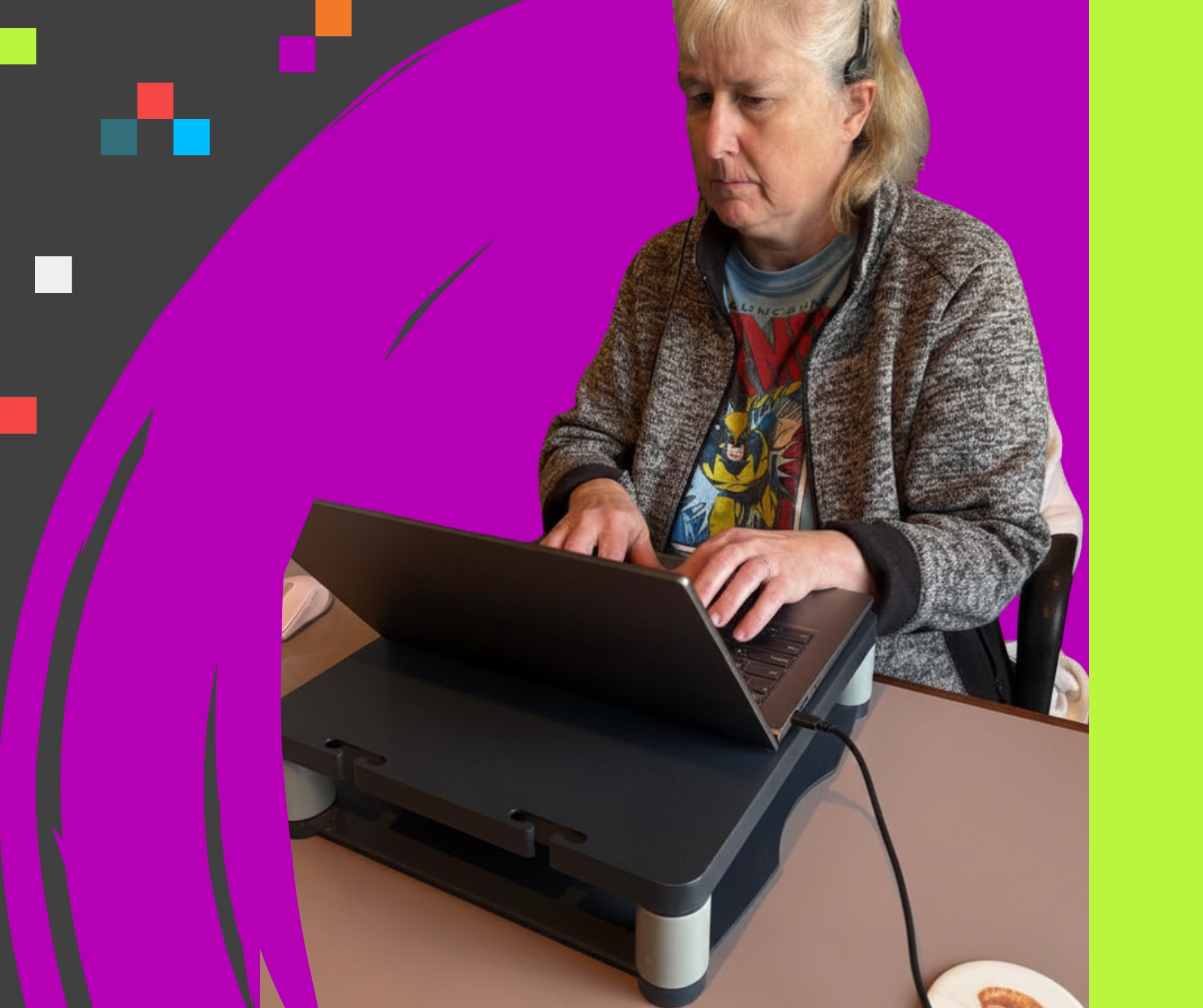
Lynn recently received a new laptop through Centre for Accessibility Australia (CFA Australia), which has changed how she manages day-to-day tasks and her independence.
Originally from England, Lynn moved to Perth in 1986 and has since lived across Melbourne, Adelaide and Perth, eventually returning to Western Australia in 2006. She has been managing changes in her vision since childhood, with her sight beginning to deteriorate around the age of seven. It later declined further in her mid-twenties, and today she has no functional vision – only light, dark and shadows.
In 2020, Lynn was diagnosed with Charles Bonnet Syndrome, which causes visual hallucinations. For her, these appear as sparkles, which she describes as looking like Christmas trees.
Throughout these changes, Lynn has remained active in her community. She has worked, volunteered and been involved in fundraising, including running a business in partnership with someone supporting organisations such as the Blind Sporting Council and Spark Disability Foundation. She has also worked as a receptionist at St Bart’s, where adjustments such as large-print text and visual aids supported her in the role at the time.
Lynn has been connected with VisAbility on and off since first arriving in Australia, initially engaging with the organisation (then the Association of the Blind) shortly after moving to Perth. After relocating interstate, she reconnected with VisAbility in 2006 and has remained a regular client since. Today, she primarily accesses support through assistive technology services, working closely with David, and is currently waiting for a new Guide Dog after recently retiring her fourth.
Before receiving her new laptop, Lynn was relying on an older device that had become increasingly difficult to use. It was slow, outdated and no longer supported the software she relied on, making everyday tasks time-consuming. At one point, she was facing the possibility of being without a usable computer altogether.
The new laptop has addressed that. Lynn now uses it alongside her phone, which she describes as her lifeline, but finds the laptop better suited to many tasks. She uses it to write letters, manage emails and stay connected with her parish council and the Mothers’ Union at her church. It has also made searching online, handling documents and general communication more efficient.
“Being able to communicate via technology on my own has given me the independence back that I thought I was going to lose,” she says.
The laptop has also improved everyday tasks that were previously unreliable. She can now scan and read documents independently, print without workarounds, and navigate more accurately using a keyboard. Having learnt to type at a young age, she values being able to use a full keyboard again.
The support surrounding the laptop has also played an important role. With guidance from VisAbility, Lynn was able to troubleshoot issues with her previous device, extend her support while transitioning, and build confidence using updated technology. “I knew I was being looked after,” she says.
Looking ahead, Lynn plans to use her laptop for job searching, updating her CV and continuing her involvement in community groups. It also helps her stay connected with friends and family, including those overseas, and plan future travel.
For Lynn, access to technology is closely linked to independence. While there are aspects of daily life where support is needed, having the right tools reduces how much she has to rely on others and allows her to stay connected and informed.
“It’s really given me my independence back,” she says.
She also highlights the importance of awareness, particularly for people who lose their vision later in life and may not know what support or technology is available. For Lynn, access to the right tools – and knowing how to use them – has made a practical difference in maintaining her independence.