
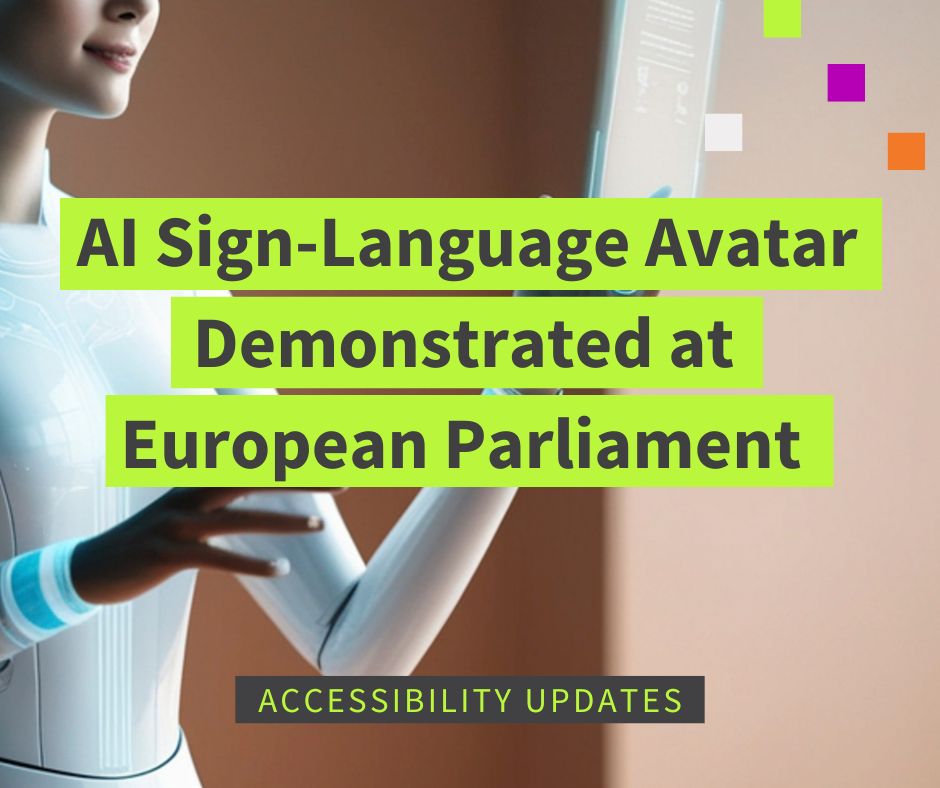
Artificial intelligence and digital accessibility were the focus of a recent conference at the European Parliament, where policymakers, researchers, disability organisations and technology companies discussed how AI can be used to make digital services more accessible.
A key demonstration at the event featured an AI-powered avatar developed by QuestIT, part of Vection Technologies. The avatar is designed to communicate using Italian Sign Language (LIS) and International Sign, allowing users who are Deaf to interact with digital services through sign language. Instead of relying solely on written text or spoken announcements, the avatar presents information in sign language to help make digital services more accessible.
The technology is already being trialled at ticket offices in Roma Termini and Milano Centrale railway stations, where it has been developed in partnership with Italy’s national association for Deaf people, Ente Nazionale Sordi. According to the organisations involved, 30 sign-language users contributed around 8,000 recorded videos to help train the system.
While the technology has the potential to improve access to digital information, speakers at the conference emphasised that AI should support and not replace qualified human interpreters. They also highlighted the importance of involving Deaf people throughout the design, testing and evaluation of accessible technologies, as well as maintaining strong safeguards around privacy, accuracy and access to human assistance.
The conference also explored how Europe can develop consistent standards for accessible AI as the European Union continues implementing the EU Artificial Intelligence Act alongside the European Accessibility Act.
Although the technology has been developed for Italian Sign Language rather than Auslan, the discussion is relevant in Australia too. As AI becomes more common in government, transport and customer service, making accessibility part of the design from the start will help ensure these technologies work for everyone.
To find out more information, please read The European Times’ article on accessible AI in European Parliament.